
Summary:
That brown ring on your ceiling near the fireplace probably isn’t a coincidence. And if it showed up after a heavy rain or a hard freeze, there’s a good chance your chimney flashing is the reason.
Flashing is the metal seal where your chimney meets your roof. When it fails — and in Ramsey County’s climate, it does fail — water gets in. Quietly, at first. Then it finds its way into your attic, your walls, and eventually your ceiling. By then, what started as a $500 fix has often turned into something much more expensive.
Here’s what you actually need to know about flashing repair: how it works, what it costs, and when it’s time to stop waiting.
What Chimney Flashing Repair Actually Involves
Flashing repair isn’t just slapping caulk over a gap and calling it done — though plenty of contractors do exactly that. Real flashing repair starts with a full inspection of the existing system to figure out whether you’re dealing with a surface-level sealant failure or something more structural underneath.
From there, the approach depends on what the inspection reveals. Minor separations or cracked sealant can often be addressed without replacing the flashing itself. But if the metal is rusted, lifted, or was installed incorrectly from the start, repair means removing the old material and doing it right from scratch.
Why So Many Flashing Repairs Fail the First Time
The most common reason a flashing repair doesn’t hold is that it never addressed the actual problem. Roofing cement and tar are go-to shortcuts — they look like a fix, and they might hold for a season or two. But they trap moisture underneath, accelerate corrosion, and almost always lead to the same leak coming back worse than before.
A proper repair uses what’s called step flashing — individual L-shaped metal pieces that integrate with each course of shingles along the side of the chimney. This is how water is actually managed off a roof. Continuous metal flashing, which some roofers install because it’s faster, doesn’t handle water flow the same way and creates exactly the kind of vulnerability that causes leaks.
The upper portion — counter flashing — is just as important. It has to be cut into the mortar joints of the chimney, not just surface-mounted with sealant. Surface-mounted counter flashing looks fine from the ground, but it lifts, separates, and lets water in. The IRC (International Residential Code) requires counter flashing to be embedded in the masonry for a reason.
One more thing worth knowing: because water travels, the visible damage inside your home often shows up far from where the water is actually getting in. A stain on your living room ceiling might trace back to a flashing gap on the back corner of your chimney. That’s why diagnosis matters as much as the repair itself — and why we always inspect the full system before touching anything.
When Repair Is Enough — and When You Need Full Replacement
Not every flashing situation calls for a complete replacement. If the metal itself is in decent shape and the failure is limited to a sealant gap or a slightly lifted edge, a targeted repair can absolutely solve the problem and hold up for years. The key is using the right material — high-quality roofing sealant, properly applied — not a temporary patch that buys you one more winter.
Replacement becomes the right call when the metal is rusted through, when sections are missing, when the original installation used continuous flashing instead of step flashing, or when the flashing is simply old enough that it’s reached the end of its useful life. High-quality aluminum flashing, installed correctly, can last as long as the roof itself. Low-grade aluminum or steel? Most chimney professionals recommend inspection after 10 years — and in Ramsey County’s climate, that timeline is not conservative.
Here’s what makes Ramsey County different from most markets: the thermal stress on flashing here is genuinely extreme. Temperatures swing roughly 110 degrees between a January night and a July afternoon. That kind of expansion and contraction loosens fasteners, cracks sealant, and separates joints over time. Add 50-plus freeze-thaw cycles per year — and the ice dams that come with them — and you have conditions that age a flashing system faster than national averages would suggest. Homes in Saint Paul’s older neighborhoods, Cathedral Hill, Summit Hill, Como, were built with original masonry chimneys that in many cases still have their original flashing. If your home dates to the mid-20th century or earlier, the question probably isn’t whether the flashing needs attention — it’s how much.
Cost to Replace Chimney Flashing in Ramsey County, MN
Cost is the first thing most homeowners want to know, and it’s a fair question. Chimney flashing repair runs $300 to $1,800 depending on the extent of the damage, the size of the chimney, the material used, and how accessible the roof is. Minor resealing can come in closer to $200. A full replacement on a larger chimney, with proper step and counter flashing, can reach $1,800 or more.
What matters more than the number itself is what you’re comparing it to. A flashing repair done now — even at the higher end of that range — is a fraction of what water damage costs once it’s worked its way into your roof sheathing, attic insulation, or interior walls. That math gets worse every season you wait.
What Drives the Chimney Flashing Cost Up or Down
Several factors move the final number in either direction. Chimney size is one of the biggest — a larger chimney has more linear footage of flashing to address, which means more material and more labor. Roof pitch matters too; steeper roofs take longer and carry more risk, which affects labor cost. Accessibility plays a role as well, especially on two-story homes or properties where the chimney sits in a difficult location on the roof.
Material choice is another variable. Aluminum is the most common and most affordable option. Copper is more expensive upfront but extremely durable and often the right call for older homes where longevity is the priority. Stainless steel sits somewhere in between. For most Ramsey County homeowners, high-grade aluminum installed correctly is the practical choice — it handles Minnesota’s thermal demands well and holds up without the premium cost of copper.
Labor typically runs around $75 per hour for a professional mason or chimney technician. On a straightforward repair, that might mean two to three hours of work. A full replacement on a larger chimney takes longer and involves more material. The honest answer is that until someone gets on your roof and sees what’s actually there, any number you find online is an estimate. That’s why we offer same-day estimates — not to rush the decision, but because you shouldn’t have to wait a week just to find out where you stand.
One thing worth noting for homeowners weighing the cost: some flashing damage is covered under homeowner’s insurance, particularly if it resulted from a storm or a sudden event. It’s worth checking your policy before assuming you’re paying out of pocket.
Roof and Chimney Repair: Why You Shouldn't Call a Roofer for This
Flashing sits at the intersection of two systems — the roof and the chimney — and that’s exactly why it causes so much confusion. A lot of homeowners call a roofer first, get told it’s a chimney problem, call a chimney company, and get told it’s a roofing issue. That cycle is frustrating, and it’s not uncommon.
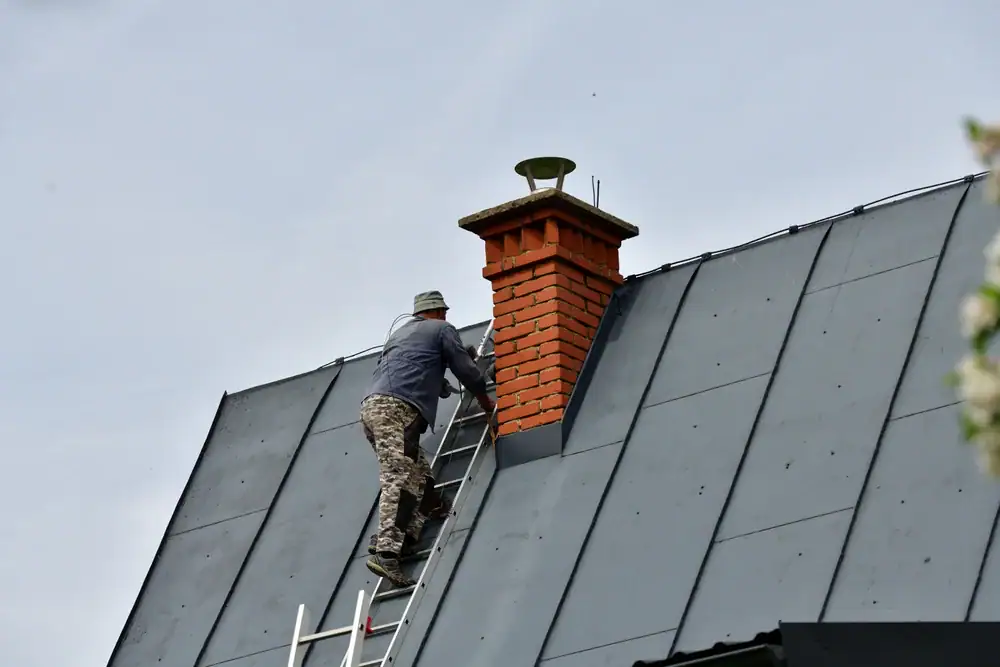
Here’s the practical reality: chimney flashing repair requires understanding both sides. The step flashing has to integrate correctly with the shingle system. The counter flashing has to be properly embedded in the chimney’s mortar joints. If you only see the roof side of the equation, you’re likely to miss what’s happening at the chimney — and vice versa. A chimney specialist who works with both systems regularly is better positioned to diagnose and fix the actual problem, not just the part of it that’s visible from their usual vantage point.
We work exclusively on wood-burning chimney systems, which means we see the full picture every time — from the firebox to the flashing. That focus matters when you’re dealing with a leak, because the solution has to account for how the chimney and roof interact, not just what’s leaking at the surface.
Timing is also worth thinking about, especially in Ramsey County. The ideal window for flashing repair is fall — before the first hard freeze — or spring, once the snow has cleared and temperatures stabilize. Summer is the best time for a full replacement, with dry conditions and stable temperatures that make for cleaner installation. Winter repairs are possible, and we do them when there’s an active leak that can’t wait, but they’re more logistically demanding. If you’ve noticed a problem this season, getting it looked at before the next freeze is always the better call.
When to Call Us for Chimney Flashing Repair in Ramsey County
If you’re seeing water stains near your fireplace, noticing rust on your chimney cap, or dealing with a smell that shows up after rain, don’t wait for it to get obvious. By the time a flashing leak is easy to see, it’s usually been working on your home for a while.
Ramsey County’s winters are hard on flashing — harder than most national guides account for. The freeze-thaw cycles, the ice dams, the snow load sitting against your chimney for months at a time — all of it shortens the window between “this is fine” and “this is a problem.” Homes in Shoreview, Roseville, Maplewood, and Saint Paul’s older neighborhoods deal with this every year.
If you want a straight answer about what’s going on with your chimney flashing, we can get someone out to take a look — often the same day you call. No pressure, no guesswork. Just a clear assessment of what you’re dealing with and what it’s going to take to fix it.