Summary:
If you’ve got an older home in Ramsey County, there’s a good chance your chimney has been standing for 80, 100, maybe 130 years. That’s a long time to handle Minnesota winters. At some point, something gives — mortar crumbles, brick starts to flake, water finds its way in. The instinct is to call someone and get it fixed. But the fix matters as much as the repair itself. Use the wrong materials on a historic chimney and you’re not solving the problem — you’re accelerating it. Here’s what you actually need to know before any work gets started.
What Historic Chimney Restoration Actually Means
Restoration isn’t just a fancier word for repair. With a modern chimney, repair usually means replacing a damaged component with a current equivalent — new mortar, a new cap, a new liner. The materials are interchangeable because the system was built with them in mind.
Historic chimneys are different. The brick used in St. Paul and throughout Ramsey County from the 1880s through the mid-1900s is softer than modern brick. The mortar holding it together was lime-based, not Portland cement. The whole system was designed to flex slightly with temperature changes — which in Minnesota means a lot of flexing.
When you treat a historic chimney like a modern one, you run into trouble fast. The restoration process is about understanding what the original system was built with and repairing it in kind.
Why Using the Wrong Mortar on a Historic Chimney Causes More Damage
This is the detail that most homeowners never hear until after something goes wrong. Modern Portland cement mortar is harder than the soft historic brick surrounding it. That sounds like a good thing — stronger mortar, more durable repair. But it works the opposite way in practice.
When a chimney expands and contracts with temperature changes — and in Ramsey County, that happens constantly, with St. Paul averaging more than 50 freeze-thaw cycles every year — something has to give. In a properly built historic chimney, the mortar gives. It’s designed to be the sacrificial element. You repoint the joints every few decades and the brick stays intact.
When you fill those joints with Portland cement, the mortar becomes the rigid element. Now the softer historic brick absorbs all the stress. It cracks. It spalls. Pieces break off. And once that starts, you’ve gone from a repointing job to a much more serious structural repair — or in bad cases, a partial rebuild.
Proper historic chimney restoration uses lime-based mortar formulated to match the hardness and flexibility of the original. It’s not a shortcut or a compromise. It’s the technically correct approach for the material you’re working with. Any mason or chimney technician who doesn’t bring this up when quoting work on an older home either doesn’t know it or isn’t telling you.
The same logic applies to brick replacement. If sections of your chimney need new brick, matching the original isn’t just about aesthetics. Modern brick is often a different dimension and density than historic brick. Mixing the two creates inconsistencies in how the wall moves and breathes, which leads to new failure points over time. Salvaged period brick or custom-matched replacements are the right call — not whatever’s sitting on a pallet at the supply house.
How Ramsey County's Climate Accelerates Historic Chimney Deterioration
Minnesota is genuinely hard on masonry. St. Paul’s temperature range runs from around -20°F in deep winter to the mid-90s in summer — a swing of more than 100 degrees. Every time moisture gets into a mortar joint or a small crack and the temperature drops below freezing, that water expands by about 9 percent. Multiply that by 50-plus freeze-thaw cycles a year, and you start to understand why chimneys in this climate age faster than in milder parts of the country.
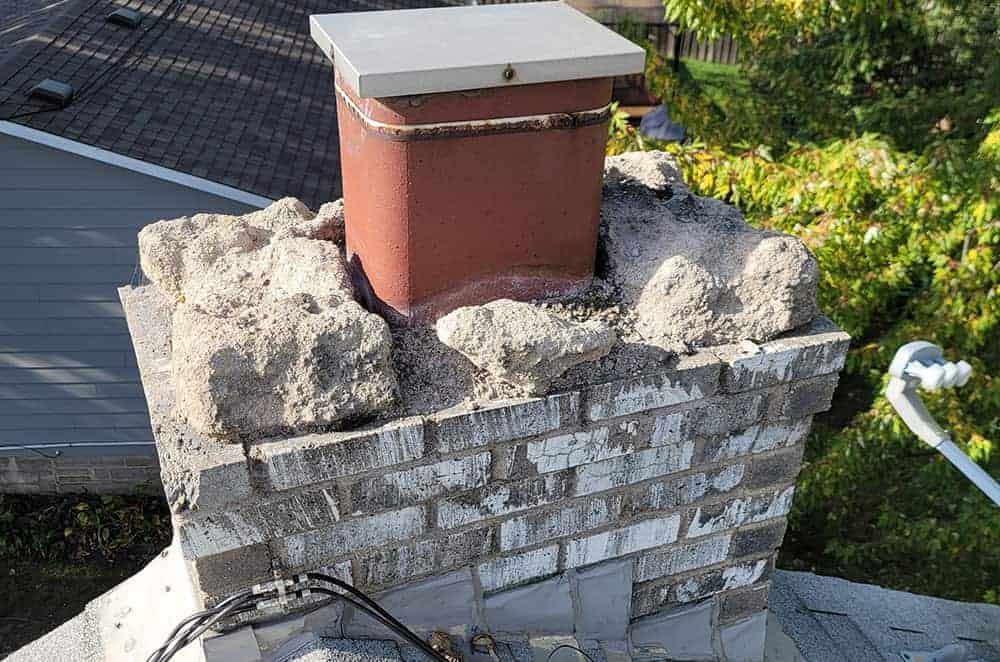
For a chimney that’s already 80 or 100 years old, the damage compounds. Mortar joints that have been slowly eroding for decades become pathways for water. Small cracks in the crown let moisture into the flue. Brick faces that have been saturated and frozen repeatedly start to spall — the outer layer breaks off in sheets or chunks. What looks like surface wear from the ground is often a sign of deeper structural stress.
This is especially relevant in older Ramsey County neighborhoods like Summit Hill, Crocus Hill, and Cathedral Hill in St. Paul, where you’ll find some of the most architecturally significant homes in the state sitting on chimneys that were last properly maintained decades ago. The same goes for first-ring suburbs like Roseville, Maplewood, and North St. Paul, where 1940s and 1950s homes are now hitting the age range where their chimney systems need serious attention for the first time.
The climate argument for doing restoration correctly — using the right mortar, matching the original materials, addressing water infiltration at the source — isn’t abstract. It’s the difference between a repair that lasts 30 years and one that needs to be redone in five.
Stucco Chimney Repair in Older Ramsey County Homes
Not every historic chimney in Ramsey County is exposed brick. A significant number of homes from the 1920s through the 1950s have stucco-coated chimneys — a cement-based exterior finish applied over the underlying masonry to create a smooth or textured surface. It was common in the era, and it holds up reasonably well until it doesn’t.
When stucco starts to crack or delaminate, water gets behind the coating and into the masonry beneath. Left alone, that leads to the same freeze-thaw damage described above, except it’s happening inside the wall where you can’t see it. Stucco chimney repair isn’t just patching the surface — it means addressing what’s underneath before recoating.
What Proper Stucco Chimney Restoration Involves
The mistake most people make with a stucco chimney is treating the cracks as a surface problem. They apply patching compound, it looks fine for a season, and then the cracks come back — usually wider. That’s because the cracks are a symptom, not the cause. The underlying masonry has shifted, or moisture has been working behind the stucco for longer than the surface suggests.
Proper stucco chimney repair starts with removing the damaged sections entirely — not just filling them. Once the old stucco is off, you can actually see the masonry beneath and assess what’s going on. If there’s brick or mortar damage underneath, that gets addressed first. Then the stucco is reapplied in layers, matching the original texture and profile as closely as possible.
Texture matching matters more than it might seem. On a historic home, a chimney with a noticeably different stucco finish is a visible reminder that something was done to the house — and not always in a good way. The goal with restoration is for the repair to disappear into the original. That takes more care and more skill than a basic patch, but it’s the right result.
The other consideration specific to stucco chimneys is waterproofing. Stucco is porous, and once it’s been compromised once, it needs proper sealing to prevent the cycle from repeating. The right product here is a vapor-permeable penetrating sealer — not a film-forming coating that traps moisture inside the masonry. Getting that detail wrong can cause as much damage as the original problem.
How to Choose Masonry Repair Companies for Historic Chimney Work
Most homeowners get a few quotes and pick based on price. That works fine for a lot of home repairs. For historic chimney work, it’s a genuinely risky approach — because the cost of the wrong repair isn’t just the money you spent. It’s the additional damage that repair causes, and what it costs to fix that later.
The first thing to look for is whether the company actually specializes in chimneys, not just masonry broadly. A general masonry contractor may be skilled at new construction or flatwork, but chimney systems have specific requirements around combustion safety, draft, liner integrity, and flue dynamics that go beyond standard masonry knowledge. CSIA certification — from the Chimney Safety Institute of America — is the clearest signal that a technician has been trained specifically in chimney systems. It’s a nationally recognized credential that requires renewal every three years, so it reflects current knowledge, not just something earned once a decade ago.
For historic work specifically, you want someone who asks about the age of the home before they start talking about solutions. A technician who shows up, looks at the chimney, and immediately starts talking about Portland cement mortar or modern brick replacement hasn’t thought carefully about what they’re working with. The right technician asks questions, does a full inspection, and explains what they found before recommending anything.
It’s also worth asking directly whether they have experience with homes from your era of construction. A chimney built in 1910 is a different project than one built in 1985. The materials are different, the failure patterns are different, and the repair approach should reflect that. If a company can’t speak to that distinction, that’s useful information.
Finally, reliability matters — and it’s one of the most common complaints in this industry. Slow response times, missed appointments, vague estimates. A company that sends a technician out the same day for an estimate and communicates clearly throughout the process is telling you something about how they operate. That matters as much as the technical work, because a great technician who doesn’t show up on time isn’t actually solving your problem.
Getting Historic Chimney Restoration Right in Ramsey County, MN
The short version: historic chimneys need specialist care, and the details matter. The wrong mortar, the wrong brick, the wrong approach to stucco repair — any of these can turn a manageable problem into a significantly more expensive one. In a climate like St. Paul’s, where freeze-thaw cycles do real structural damage every single year, there’s not much margin for a repair that’s almost right.
If your home is older and your chimney hasn’t been properly assessed in a while, the best first step is a full inspection by someone who actually understands what they’re looking at. Not a cleaning visit — a real structural evaluation.
We work exclusively with wood-burning systems across Ramsey County and the Twin Cities, with certified, licensed, and insured technicians who specialize in exactly this kind of work. If you want to know where your chimney stands before another winter hits it, reach out — we offer same-day estimates and back everything we do with a 100% Satisfaction Guarantee.