
Summary:
Most homeowners don’t think about their chimney until something goes wrong. A smell, a stain on the ceiling, a crack that wasn’t there last spring. By that point, what might have been a straightforward repair has often turned into something much bigger — and much more expensive.
The good news is that most serious chimney problems don’t appear overnight. They develop slowly, and a proper chimney inspection catches them early, when the fix is still manageable. Here are five red flags that come up regularly in Ramsey County homes — and what you’re looking at in terms of repair costs if you let them go.
What a Chimney Inspection Actually Looks For
A chimney inspection isn’t someone glancing up your flue with a flashlight. A proper inspection covers the exterior masonry, the crown, the cap, the flue liner, the smoke chamber, the damper, and the firebox — the full system. What gets checked and how thoroughly depends on the level of inspection, but even a standard annual inspection should give you a clear picture of what’s going on.
The reason this matters is that most of the dangerous stuff isn’t visible from your living room. A cracked flue liner, a deteriorating smoke chamber, or a compromised crown can exist for years without any obvious sign — until there’s a chimney fire, a carbon monoxide issue, or water damage spreading through your walls.
Why Ramsey County Homes Are Especially Vulnerable to Hidden Chimney Damage
If you live in St. Paul — especially in neighborhoods like Summit Hill, Cathedral Hill, Como Park, or Macalester-Groveland — your home’s chimney may be anywhere from 80 to 140 years old. The original clay tile flue liners in those homes have a functional lifespan of around 50 years. The mortar joints in pre-WWII masonry were designed to last about 25 years. Do the math, and it’s clear why so many inspections in these neighborhoods turn up serious issues that the homeowner had no idea about.
Inner-ring suburbs tell a similar story. Homes in Roseville, Maplewood, Shoreview, and New Brighton were largely built in the 1950s through 1970s. Those chimneys are now 50 to 75 years old — well into the range where original materials start to fail in meaningful ways.
Then there’s the climate. The Twin Cities experiences some of the most aggressive freeze-thaw cycling in the country. Water works its way into small cracks in mortar and masonry, freezes, expands by roughly 9 percent, and widens the gap. That process repeats 30 to 40 times in a typical Ramsey County winter. A hairline crack in October can be a structural gap by March. Give it two or three winters unaddressed, and you’re looking at a much bigger repair bill.
The 5 Red Flags That Show Up Most Often During Chimney Inspections
The first red flag is white staining on the exterior of your chimney — called efflorescence. It’s caused by water moving through the masonry and depositing mineral salts on the surface. The staining itself is harmless, but what it tells you isn’t: water is getting in. Left alone, that moisture infiltration leads to spalling bricks, deteriorating mortar joints, and eventually structural damage.
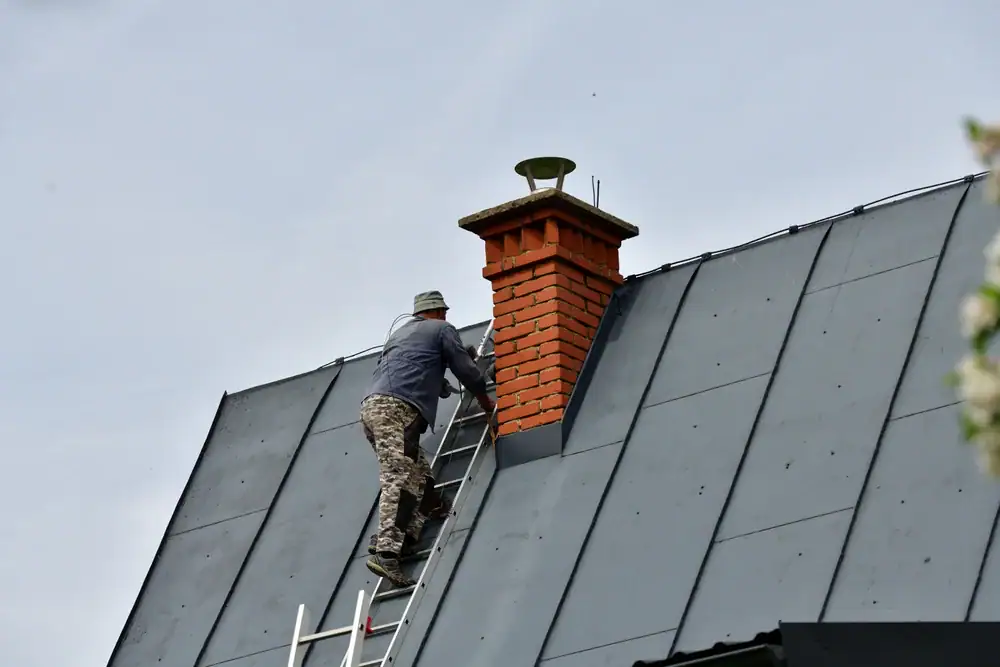
The second is a damaged or missing chimney crown. The crown is the concrete or mortar cap that seals the top of the chimney around the flue. When it cracks or crumbles — which happens regularly in Minnesota winters — water pours directly into the chimney system. Crown repair typically runs $750 to $1,000. A full crown replacement is more, but still far cheaper than the water damage that follows if you ignore it.
The third is a rough or deteriorating smoke chamber. The smoke chamber is the funnel-shaped area just above the firebox that channels combustion gases into the flue. When the interior surface is rough or damaged, creosote builds up faster and the risk of a chimney fire goes up. Fixing this involves a process called chimney parging — applying a mortar or spray-on coating to smooth and seal the surface. In Ramsey County, chimney parging cost typically falls between $1,000 and $2,000, with local labor rates pushing toward the upper end of that range.
The fourth is a visible lean or separation from the house. If your chimney appears to be pulling away from the structure or leaning to one side, that’s a structural problem — not a cosmetic one. It usually points to foundation movement, severe mortar erosion, or both. Leaning chimney repair cost averages $2,000 to $4,000 for stabilization work, but if the lean has progressed far enough to require a partial or full rebuild, costs can climb well past $10,000. Catching this early is the difference between a manageable repair and a major project.
The fifth is a cracked or deteriorating flue liner. The liner is what protects your home’s framing from the heat and gases produced by your fireplace. Cracks in the liner create pathways for carbon monoxide to seep into living spaces — and for heat to reach combustible materials in your walls. This is the red flag with the highest safety stakes, and it’s one you genuinely cannot see without a proper inspection.
Chimney Repair Costs in the Twin Cities: What to Expect
One of the most common reasons homeowners delay getting a chimney inspection is cost uncertainty — they don’t know what they’ll be told they need, and they don’t want to commit to a service call without some sense of what the numbers might look like. That’s a fair concern, and it’s worth being direct about it.
Repair costs in the Twin Cities metro generally run at or above national averages, reflecting local labor rates and the added complexity of cold-weather construction. Here’s a realistic picture of what common repairs cost in Ramsey County.
Chimney Foundation Repair Cost and What Causes It in Minnesota
Chimney foundation problems are more common in Minnesota than in most other parts of the country, and the reason comes down to frost. The frost line in the Twin Cities sits between 42 and 48 inches deep. When the ground freezes to that depth each winter and thaws each spring, it creates significant movement in the soil beneath a chimney’s foundation — a process called frost heave. Over time, that repeated shifting causes the foundation to crack, settle unevenly, or fail.
Chimney foundation repair cost in this region typically ranges from $1,500 to $3,500 for moderate cases. When the foundation damage is severe enough to require helical piers — steel anchors driven deep into stable soil to stabilize the structure — costs increase substantially. The key variable is how long the problem has been developing. A foundation that’s been shifting for two or three years is a very different repair than one that’s been moving for a decade.
Foundation issues are also closely connected to the leaning chimney problem described earlier. In many cases, a visible lean is a symptom of foundation failure underneath. That’s why a thorough chimney inspection looks at the full system — identifying a lean without investigating the foundation beneath it doesn’t give you the full picture.
If you’re in an older St. Paul neighborhood or a mid-century suburb like Maplewood or Shoreview and your chimney hasn’t been inspected in several years, foundation movement is one of the things worth specifically asking about.
Chimney Restoration Cost: When Repairs Add Up to a Bigger Project
Sometimes a chimney inspection doesn’t turn up one problem — it turns up several. A damaged crown, deteriorating mortar joints, a rough smoke chamber, and a worn cap can each be addressed individually, but when multiple issues exist at the same time, it often makes more sense to approach it as a restoration rather than a series of separate repairs.
Chimney restoration cost varies considerably depending on scope. Targeted restoration work — tuckpointing, crown repair, parging, and waterproofing — typically falls in the $1,500 to $4,000 range. More comprehensive work involving liner replacement, significant brick repair, or structural rebuilding can push costs to $10,000 or more. For homes in St. Paul’s historic neighborhoods where original masonry has been in place for 80 to 100+ years, full restoration is sometimes the most cost-effective path forward, because piecemeal repairs on severely deteriorated masonry tend to require repeat visits.
The other situation where restoration comes up regularly is home sales. NFPA 211 — the national standard governing chimney inspections — requires a Level 2 inspection when a property changes hands. In active real estate markets throughout Ramsey County, buyers and sellers frequently need a clear picture of chimney condition before closing. A restoration that brings everything up to current standards can remove a significant negotiating obstacle.
It’s also worth noting what restoration doesn’t mean. It doesn’t mean tearing everything down and starting over unless the structure genuinely warrants it. We look for the most targeted solution that actually solves the problem — not the most expensive one.
When to Schedule a Chimney Inspection in Ramsey County, MN
The honest answer is: if you haven’t had one in the past year, the right time is now. Not because something is definitely wrong, but because the only way to know is to look. The problems that cost the most — cracked liners, foundation movement, structural leaning — are the ones that develop quietly and show up late.
For Ramsey County homeowners, the stakes are a little higher than average. The housing stock is older, the winters are harder on masonry than almost anywhere else in the country, and the heating season runs seven months. Annual inspection isn’t just industry advice — it’s practical math.
If you’ve noticed any of the warning signs covered here, or if it’s simply been a while, we serve all of Ramsey County and offer a free chimney sweep and cleaning with every annual inspection. New customers get $25 off, and we can typically get someone out the same day you call. Reach us at 651-399-2759.