Summary:
It is a fair question, and if you are asking it in September or October, you are asking it at the right time. If you are asking in December, the answer is probably going to sting a little.
Chimney masonry in Minnesota is not something you can schedule whenever it is convenient. The climate here sets the schedule, and it is less forgiving than most homeowners expect. There is a real, science-backed deadline for when mortar work can be done properly, and once that window closes, it stays closed until spring.
Here is what that deadline is, why it exists, and what it means for your chimney if the work does not happen before winter.
When Does Chimney Masonry Season Close In Minnesota?
The short answer is mid-to-late November, most years. That is when overnight temperatures across the Twin Cities metro (from Hennepin County to Dakota County, Scott County to Washington County) start dropping consistently below the threshold where mortar can cure properly. Once that happens, quality masonry work is not possible without expensive cold-weather enclosures that most residential jobs do not justify.
The longer answer involves understanding why the cutoff exists in the first place. Mortar is not just filler. It is a chemically active material that needs sustained warmth to bond correctly. When that process gets interrupted by freezing temperatures, the results are structural.
What Temperature Is Too Cold For Chimney Tuckpointing Or Masonry Repair?
Mortar needs temperatures to stay above 40°F, not just during application, but for roughly 24 hours before the work begins and for at least 72 hours after. That is not a preference. It is a curing requirement. When mortar freezes before it has had time to bond, it pits, spalls, and loses structural integrity. In some cases, it fails before the season is even over.
This is why a contractor who works in marginal conditions, such as a 38°F afternoon with a hard freeze forecast for that night, is not doing you any favors, even if they are willing to show up. The work might look fine on the surface, but the bond underneath may already be compromised.
In the Twin Cities and surrounding counties, that 40°F sustained window becomes unreliable in mid-to-late November. Some years you get a warm stretch into early December. Other years, the window closes in late October. The point is that by the time you are thinking about Thanksgiving, you are likely past the safe threshold for mortar work, and there is no catching up once winter sets in.
There is also a wind chill factor worth knowing about. Even when the air temperature reads above 40°F, a sustained wind can pull heat out of freshly applied mortar faster than it can cure. Professional contractors working near the end of the season account for this by checking multi-day forecasts, starting later in the morning after overnight frost has cleared, and paying attention to exposure on the chimney’s north and west faces. These are not details a low-bid contractor is likely to think about.
If you are in Eagan, Lakeville, Woodbury, or anywhere else across Hennepin, Ramsey, Dakota, Scott, or Washington counties and you are reading this in October, you probably still have time. If it is mid-November, the window may already be closing. A quick call to confirm the forecast window for your specific job is always worth it.
What Happens To An Unrepaired Chimney Over A Minnesota Winter?
This is the part most homeowners underestimate. It is not that the chimney will collapse over winter, but that the damage compounds in ways that are hard to predict and expensive to fix.
Here is the mechanism: water gets into an open mortar joint. When temperatures drop below freezing, that water expands by roughly 10% in volume. In a climate like ours, where the Twin Cities sees approximately 40 to 60 freeze-thaw cycles every year between October and April, that expansion and contraction happens dozens of times over the course of a single winter. Each cycle pushes the mortar joint a little wider, works the brick faces a little looser, and moves moisture a little deeper into the structure.
What starts as a mortar repair can become a partial rebuild by spring. What was a crown crack can become a water-damaged firebox. The math on this is brutal: a tuckpointing job that costs a few hundred dollars in October can turn into a structural rebuild costing several times that after one hard Minnesota winter. That is not a sales pitch; it is just what freeze-thaw cycling does to masonry over six months.
This is especially true for older homes in Minneapolis, St. Paul, and the inner-ring suburbs. The soft historic brick in those neighborhoods was built to work with softer, lime-based mortar. When that mortar deteriorates and water gets in, the brick itself becomes vulnerable, affecting more than just the joints. Unlike mortar, brick is not easily patched. Once the faces start spalling, you are often looking at a more significant repair.
Homes in newer communities like Prior Lake, Savage, Farmington, and Cottage Grove have their own version of this problem. Chimneys built in the 1980s through 2000s are hitting their first major maintenance cycle. They may look structurally fine from the driveway, but hairline cracks in the crown and deteriorating mortar joints are common at this age, and they are exactly the kind of thing that gets dramatically worse after a Minnesota winter without attention.
How To Know If You Need Tuckpointing Or A Full Chimney Rebuild
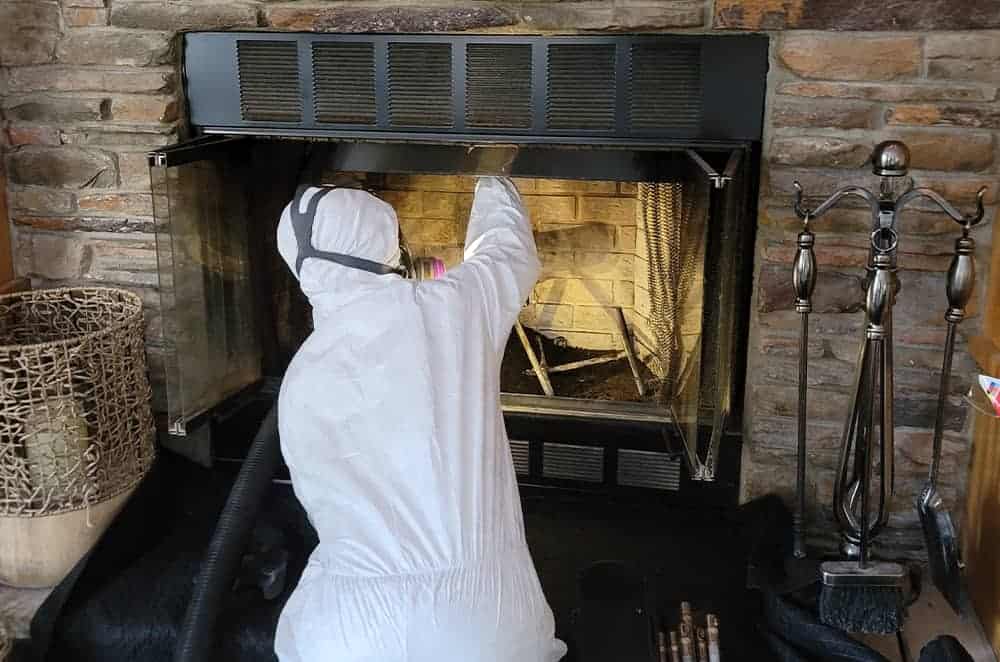
It depends on the type and extent of the damage, which is why a real inspection matters before you light the first fire of the season.
Exterior mortar deterioration does not automatically mean the flue is compromised. A chimney can have visible tuckpointing needs on the outside while the interior flue liner is still intact and functioning safely. Conversely, a chimney that looks presentable from the driveway can have a cracked liner, a deteriorating crown, or flashing failures that are actively allowing water into the structure.
The concern with using a damaged chimney is not just fire risk, though that is real. It is also carbon monoxide. A cracked or deteriorated flue liner can allow combustion gases to migrate into the living space rather than venting properly to the outside. This is invisible and odorless, which is part of why annual chimney inspections exist in the first place.
For homeowners across Dakota County, Scott County, Washington County, and the Twin Cities metro, the fall inspection window before the heating season begins is the practical time to get an honest answer about whether your chimney is ready to use. This is not because of manufactured urgency, but because waiting until January to discover a problem means waiting until spring to fix it, and using a compromised chimney all winter in the meantime.
If you noticed damage during the summer, such as white staining on the brick face (efflorescence), visible mortar crumbling, a crack in the chimney crown, or water spots near the fireplace, those are signs worth taking seriously before the heating season starts. None of them are automatically catastrophic, but none of them are things to ignore either. An honest assessment will tell you which category you are in.
The NFPA recommends annual chimney inspections for a reason. In a climate like Minnesota’s, where chimneys work hard for six months straight and then spend the other six months cycling through freeze-thaw stress, that recommendation is practical.
Why Mortar Matching Matters More Than Most Contractors Admit
Here is something that does not get talked about enough: not all mortar is the same, and using the wrong type can make things worse.
Modern mortar mixes tend to be high in Portland cement, which makes them hard and rigid. That sounds like a good thing, but it is not on older chimneys. The mortar joint in a masonry chimney is designed to be the sacrificial element. It is supposed to be slightly softer than the surrounding brick so that seasonal stress gets absorbed by the joint rather than the brick face. When you replace old, soft lime-based mortar with a hard modern mix, the brick becomes the weak point. Over time, the faces crack and spall, and now you have a brick problem instead of a mortar problem.
This matters a lot in Minneapolis, St. Paul, and the older suburbs across Hennepin and Ramsey counties, where a significant portion of the housing stock was built in the early-to-mid 1900s with soft historic brick. A contractor who shows up with whatever mortar is on the truck, without evaluating the existing material and matching the hardness and color, is doing work that looks fine today and causes problems in a few years.
Proper mortar matching takes time and knowledge. It is the detail that separates a mason who understands the material from one who just knows how to apply it. When you are getting an estimate, it is worth asking directly how they are matching the mortar to your existing brick. The answer will tell you a lot.
This is also why a roof-level inspection matters before any quote. Mortar condition, crown integrity, and brick surface deterioration are not visible from the ground. A contractor who quotes without getting up on the roof has not seen what they are quoting.
Is It Safe To Use My Fireplace If The Chimney Masonry Is Damaged?
Still Have Time To Schedule Chimney Masonry Repairs This Fall In Minnesota?
If you are reading this before mid-November, the answer is likely yes, but the window is real and closes without much warning. One hard cold snap can end the viable masonry season for the year, and there is no making up for it until temperatures stabilize again in spring.
The good news is that most chimney masonry issues caught before winter are manageable. The ones discovered after a full Minnesota winter of freeze-thaw cycling are a different story. Getting an honest assessment now, one that shows you what needs attention and what can wait, is the useful thing you can do for your chimney before the season closes.
Call Suburban Chimney Solutions today to schedule your inspection before the fall booking window fills up!